#TESL0120
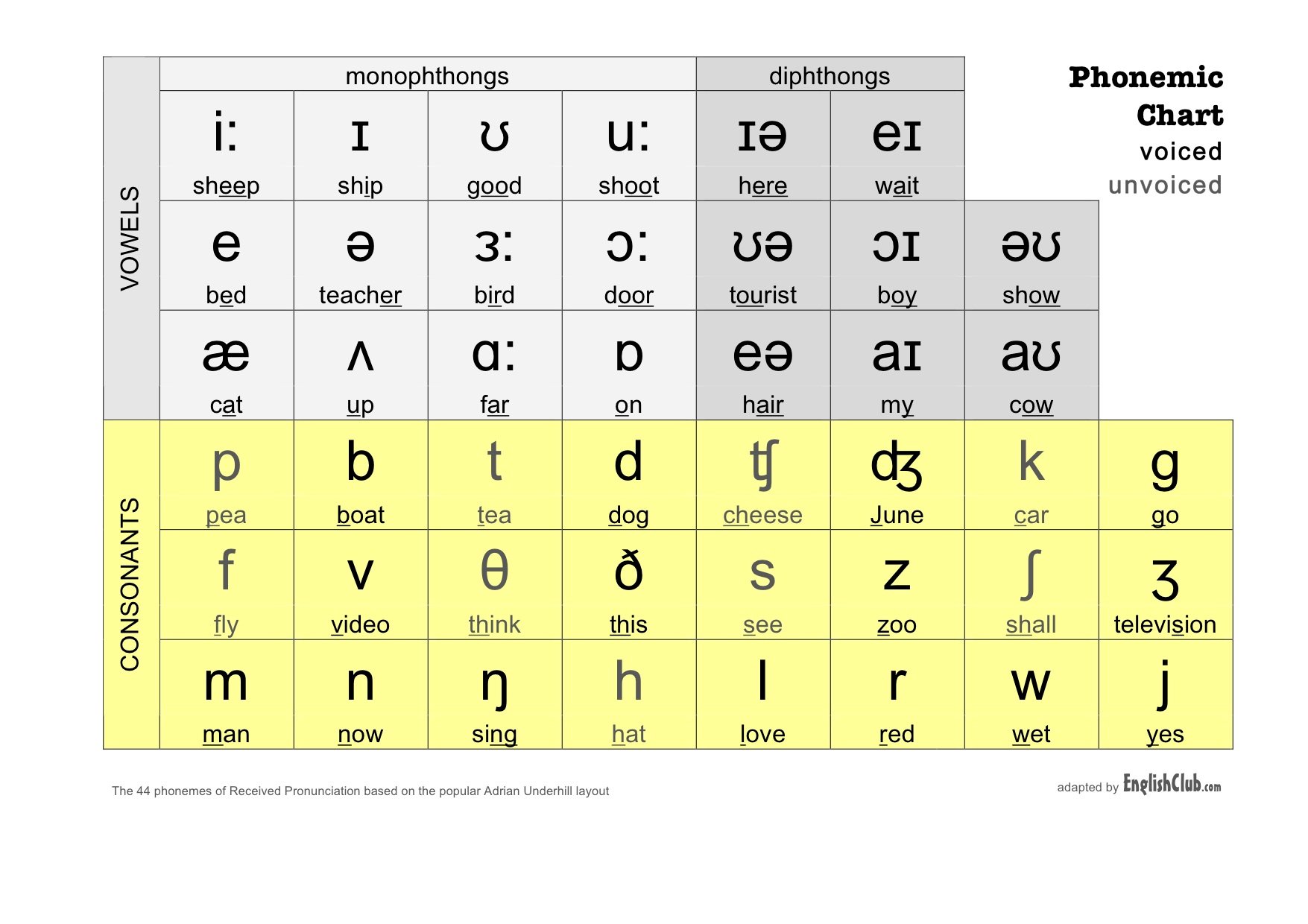
I remember the schwa /ə/ from some language class in the distant past as the pronunciation of the letter 'e' that English speakers use when they get a little lazy and don't quite make it to the 'e' in 'bed. I don't equate it with how I pronounce the 'er' at the end of "teacher", which is the example given by EnglishClub.com (2018) in their Phonemic Chart. I attribute this difference to the chart being based on British English associated with the accent of southern England. To me, it is the vowel sound I use for "the" or the second 'e' in "television".
Imagine my surprise when I was confronted by 43 more of these odd looking symbols that I will have to learn and be prepared to use in teaching English pronunciation. Of course it isn't actually as bad as that. Seventeen of them (e, p, b, t, d, k, g, f, v, s, z, m, n, h, l, r, w) are letters of the English alphabet that I already associate with their assigned phonemes. One is an upper case version (I) that requires attention to the font. Four of the consonants are intuitive ( ʃ, __ʧ, ʤ), and three of them I recognize from other alphabets that are familiar to me (ð - used in Icelandic , θ - greek, used in math, j - also used in Icelandic with the given pronunciation of the 'y' in "yes"). Remaining are about seventeen vowel phonemes whose symbols will take time for me to make sense of.
Learning these symbols, most of which are altered versions of familiar alphabet shapes, will be a challenge, but the process will give me further insight into what my future students will face.
Resources:
EnglishClub.com (2018), Phoneme Chart, [printable image], retrieved from https://www.englishclub.com/images/pronunciation/Phonemic-Chart.jpg
Sunday, September 23, 2018
Monday, September 17, 2018
Leaving the NEST
#TESL0100
![]() |
| Creative Commons: Free for reuse; No attribution required |
As someone
whose L1 is English, I have wondered why many of my TESL professors and
classmates are L2 English speakers. After reading Chapter 8 of Brown and Lee
(2015) and the introduction stories of my current classmates, I am now able to
understand why this is the case. I can also see how this can be a great
advantage, both to students and to the ESL teaching community.
Brown and
Lee (2015) use the terms “native English-speaking teachers” (NESTs) and “nonnative
English-speaking teachers” (NNESTs), and further states, “NESTs are…not better teachers than NNESTs by
virtue of their ‘native’ language background. The most important qualification
for a teaching position is training
and experience in teaching languages.”
(p. 165) I felt discouraged when I first read this, but then I realized that “not
better” doesn’t mean to imply worse, and that training is the most important factor.
Among the
advantages of being a NNEST listed by Brown and Lee is that of “familiarity
with what it is like to learn the target language as an L2 and be more
empathetic with students about their needs and challenges.” As a NEST, I do not
have this advantage. However, as a lifelong L2 learner of French, I find that I
can relate to the concepts, situations and difficulties that are presented by
my TESL courses. I have been exposed to a number of different learning
situations in the process of my L2 learning, and I can reflect on how they were
successful or not, and identify the methods and teaching philosophies behind
each of them.
I also have
the advantage of being able to call on my ever-expanding PLN – my classmates,
my instructors and the wider ESL teaching community. This community is
geographically diverse, but they are most welcoming and willing to share their
experiences, resources and opinions with teachers and learners alike. I look
forward to the resumption of the bi-weekly #CDNELTchat (formerly #LINCchat) sessions
on Twitter.
Resources:
Brown, H.D. & Lee, H., (2015), Teaching by Principles: An Interactive
Approach to Language Pedagogy, 4th ed., Pearson Education Inc.,
White Plains, NY, pp. 156 - 174.
Wednesday, September 12, 2018
Back to the beginning
#TESL0100
My Personal Learning Network Diagram
After having taken all but two of the TESL courses last fall and in the spring of this year, I now find myself going back to the beginning, that is the Fundamentals course. Of course there is some overlap with what I have already learned, but going back to the beginning has prompted me to think about and reaffirm my reasons for embarking on this challenging field of study.
Since I have not previously been a language teacher (although it could be argued that Mathematics is a kind of language), I sometimes feel out of place or inadequately prepared to take on this task. However, after reading the introductions by my classmates, I am reassured that we all come to this with different backgrounds and skills, I am reassured that my teaching experience, along with my own love of language and penchant for learning, will serve me well in this pursuit.
I am also delighted to see that the size of the class is much larger that it was last year, indicating that this area of teaching is growing and that we will continue to expand the cohort of teachers and learners who can help and encourage each other.
Here's an older approach to language instruction:
"Pickering, we have taken on a stiff job." -Henry Higgins, Pygmalion (1912) by George Bernard Shaw
My Personal Learning Network Diagram
After having taken all but two of the TESL courses last fall and in the spring of this year, I now find myself going back to the beginning, that is the Fundamentals course. Of course there is some overlap with what I have already learned, but going back to the beginning has prompted me to think about and reaffirm my reasons for embarking on this challenging field of study.
Since I have not previously been a language teacher (although it could be argued that Mathematics is a kind of language), I sometimes feel out of place or inadequately prepared to take on this task. However, after reading the introductions by my classmates, I am reassured that we all come to this with different backgrounds and skills, I am reassured that my teaching experience, along with my own love of language and penchant for learning, will serve me well in this pursuit.
I am also delighted to see that the size of the class is much larger that it was last year, indicating that this area of teaching is growing and that we will continue to expand the cohort of teachers and learners who can help and encourage each other.
Here's an older approach to language instruction:
"Pickering, we have taken on a stiff job." -Henry Higgins, Pygmalion (1912) by George Bernard Shaw
Wednesday, April 18, 2018
Observation Report, Teaching Journal and Continuing Professional Development
My final reports on my Observation Experience, my Teaching Experience and my Continuing Professional Development are on separate pages on the tabs at the top of this page.
#TESL0170
##classroomobservation
#observationreport
#TESL0170
##classroomobservation
#observationreport
#teachingreflections
#evaluationfeedback
#CPD
#networking
#evaluationfeedback
#CPD
#networking
#CdnELT
Thursday, April 12, 2018
Teaching Speaking Day 5
Today was the final day of my Student Teaching experience. I hoped to have some fun with the students and try out some new-to-me technology. For the most part, this was successful, although most of the students are very serious about their learning and take a bit of time to relax and enjoy themselves.
On reading the blog posts of one of my classmates, I finally realized how the online quiz game Kahoot! works between the teacher's computer and the students' smart phones, and I was eager to try it. It has both a quiz function and a survey function, so I decided to use it to review the vocabulary from the last class as well as to do my Student Teacher evaluation survey. As a warm-up, I used the game to do a ten-question vocabulary quiz. The questions and correct answers are linked below. You can also view and try the game with the link in my Resources list, if you sign in as a teacher.
There is also a link to the Teacher Evaluation interactive survey. in the Resources list, and a link to the questions in document form below. Since I used the interactive app to do the survey, I gave the students slips of paper to write their additional comments and I had my sponsor teacher collect them. The students were able to answer anonymously if they chose to. The results of the survey will be part of a later blog post.
After the remaining pairs from the previous day had presented their dialogues, I reassigned the groups for the remainder of today's lessons. The second activity had the students reading a case study (The Tips Jar) on a misunderstanding about tipping in cafés. I had them take turns asking and answering discussion questions, which are in the link below. I again provided answer prompts and modeled some of them to encourage the students to answer in sentences. After time for group discussions, I asked some of the students to share their answers. I kept track of who I asked, so that each student would be asked to share at least once during the class.
For the third activity, I displayed a list of items in a table setting, and had the groups/pairs attempt to sketch a North American formal table setting on a piece of graph paper. I was impressed by the detail that some of the students included. After they had some time to sketch, I handed a paper cut out of one of the items to each student and had them arrange them on the white board (with painters tape). I used an app on my phone called Instant Buttons to provide sound effects during the activity: applause for success, air horn for something that needed to be changed, and some encouraging music while the students were placing their items. I intended to have them come up one at a time, but after the first few, everyone was up at once.
The final activity used a description of bad eating habits in the textbook. I assigned one habit to each group and after they read the description in the book, the students were to look up the same habit using their smart phones. Each partner was to use different ways of phrasing the question, in order to see that they would often get a different result if the questions was phrased differently. I provided alternate search phrases for the first two habits. (See the link for Student Instructions below.) I instructed the students to take brief notes on what they found, and then asked some to share what they found.
I did not need the contingency activity and there was not time to play the closing video. I thanked the students and my sponsor teacher and received some real-time applause. It was a great experience!
Lesson Plan
Student Teacher Evaluation Survey
Student Instructions and Discussion Questions
Vocabulary Questions for Kahoot! game
Alternate Student Work Pages (for a student who is not always able to participate in the discussions.)
My Teaching Strengths:
Resources:
Proposal
at the Drive Thru: Gaber, Jared. (May 24, 2014). Tim Horton’s Marriage Proposal. [video file]. Retrieved from https://www.youtube.com/watch?v=RwsRTS8Fuu8.
The Course Outline, Instructor's Guide and the Curriculum for the course were provided by the school, but cannot be cited due to privacy requirements.
#TESL0170
#teachingreflections
#CdnELT
On reading the blog posts of one of my classmates, I finally realized how the online quiz game Kahoot! works between the teacher's computer and the students' smart phones, and I was eager to try it. It has both a quiz function and a survey function, so I decided to use it to review the vocabulary from the last class as well as to do my Student Teacher evaluation survey. As a warm-up, I used the game to do a ten-question vocabulary quiz. The questions and correct answers are linked below. You can also view and try the game with the link in my Resources list, if you sign in as a teacher.
There is also a link to the Teacher Evaluation interactive survey. in the Resources list, and a link to the questions in document form below. Since I used the interactive app to do the survey, I gave the students slips of paper to write their additional comments and I had my sponsor teacher collect them. The students were able to answer anonymously if they chose to. The results of the survey will be part of a later blog post.
After the remaining pairs from the previous day had presented their dialogues, I reassigned the groups for the remainder of today's lessons. The second activity had the students reading a case study (The Tips Jar) on a misunderstanding about tipping in cafés. I had them take turns asking and answering discussion questions, which are in the link below. I again provided answer prompts and modeled some of them to encourage the students to answer in sentences. After time for group discussions, I asked some of the students to share their answers. I kept track of who I asked, so that each student would be asked to share at least once during the class.
For the third activity, I displayed a list of items in a table setting, and had the groups/pairs attempt to sketch a North American formal table setting on a piece of graph paper. I was impressed by the detail that some of the students included. After they had some time to sketch, I handed a paper cut out of one of the items to each student and had them arrange them on the white board (with painters tape). I used an app on my phone called Instant Buttons to provide sound effects during the activity: applause for success, air horn for something that needed to be changed, and some encouraging music while the students were placing their items. I intended to have them come up one at a time, but after the first few, everyone was up at once.
![]() |
| Photo by Vicky Isliefson |
The final activity used a description of bad eating habits in the textbook. I assigned one habit to each group and after they read the description in the book, the students were to look up the same habit using their smart phones. Each partner was to use different ways of phrasing the question, in order to see that they would often get a different result if the questions was phrased differently. I provided alternate search phrases for the first two habits. (See the link for Student Instructions below.) I instructed the students to take brief notes on what they found, and then asked some to share what they found.
I did not need the contingency activity and there was not time to play the closing video. I thanked the students and my sponsor teacher and received some real-time applause. It was a great experience!
Lesson Plan
Student Teacher Evaluation Survey
Student Instructions and Discussion Questions
Vocabulary Questions for Kahoot! game
Alternate Student Work Pages (for a student who is not always able to participate in the discussions.)
My Teaching Strengths:
- I used technology, paper-based resources and some physical activity to provide a variety of experiences for the students. (Confession: the cut-outs were made with an electronic cutting machine.)
- I prepared a paper-based back-up for the required Teacher Evaluation, in case the computer/phone version did not work.
- I followed up on unfinished activities from the previous class.
My Weaknesses:
- I did not include some information about how to tip and how much to tip in the Tips Jar activity. There was not enough focus on what to do in Canada.
- I did not control the students well during the place setting activity. I did not give them enough direction about when to get up and come to the front.
- I did not provide enough model search terms for the Bad Eating Habits activity, resulting in some students misunderstanding what they were to search.
- I did not check to make sure students were taking notes during the internet search for the Bad Eating Habits activity.
Genzel, Rhona B, & Cummings,
Martha Graves, (2010). Culturally Speaking,
3rd Edition. Boston: Heinle, Cengage Learning.
cremagames (2011). Instant Buttons. [computer software - smart phone app]. Madrid.
Kahoot! (2018) Teacher
Evaluation: Vicky Isliefson. [user created interactive game using web-based
software]. Retrieved from https://play.kahoot.it/#/?quizId=acca10f0-3e5a-4eea-a413-8496fcbd17e1.
Kahoot! (2018). North American
Dinner Vocabulary. [user created interactive game using web-based software].
Retrieved from https://play.kahoot.it/#/?quizId=6f69bc36-4154-432c-a5b2-996c43bfb8a7.
The Course Outline, Instructor's Guide and the Curriculum for the course were provided by the school, but cannot be cited due to privacy requirements.
#TESL0170
#teachingreflections
#CdnELT
Subscribe to:
Posts (Atom)


